Mag Magna Crop

Projects

Projects

Global Demand for magnets is

Expected to Grow Dramatically

Potential World Class targets

At present, the U.S. has only one operating Rare Earth Element (REE) mine, the Mountain Pass mine in California,

Our deep review of State geological maps and reports have provided new insights into areas studied by either the atomic energy commission or state geologic surveys that indicate areas for Heavy and Light REEs within overlooked regions.

Our Company has selected two geologic areas we believe are highly prospective for REE mineralization. These targets were chosen based on favorable geology, historic data, and their strategic location for critical mineral supply.

Hicks Dome HREES

Mineral Wealth in Nevada

Nevada stands as one of the best places in the world for mining due to its exceptional combination of rich mineral endowment, infrastructure, and stable regulatory environment.

The state is home to vast deposits of minerals, supported by a mining-friendly government and clear permitting processes that encourage investment and innovation.

REEs in Nevada

Field work by the U.S. Atomic Energy Commission (AEC) in this area identified very high, locally concentrated REEs hosted in Precambrian crystalline rocks and associated pegmatites/alkaline intrusives (allanite/monazite/xenotime mineralogy).

After the AEC identification of REEs there has no follow up. We are currently planning systematic sampling, drilling, and radiometric assessment to evaluate the areas economic potential.

Arizona - Kingsman REE

Arizona remains one of the top producers of critical minerals in the world, and Arizona consistently stands among the top five states (2nd) for non-fuel mineral resource production..

Arizona copper mining firms produced an output of $10.1 billion for the State, second to only the Arizona semiconductor industry.

Kingman - Bonanza Grades

The Kingman area lies within NW Arizona in a 1.7 billion year old Proterozoic basement suite of alkaline to peralkaline granitic and syenitic intrusions, often accompanied by pegmatitic and carbonatitic phases — exactly the rock types globally associated with Rare Earth mineralization.

The intrusives occur along with faults and fracture zones, which served as pathways for hydrothermal fluids enriched in Rare Earth Elements (REEs), thorium, uranium, and fluorine.

The Kingman Intrusives are one of only a handful of U.S. alkaline systems with both REE and thorium enrichment of potentially economic grade. Their REE distribution is favorable for high-demand magnet elements — Nd, Pr, Dy, Tb — critical for electric vehicles, wind turbines, and defense technologies.

Unlike many U.S. REE prospects, Kingman shows broad near surface mineralized zones, making it a potentially low-cost, open-pittable target.

Kingman- high REE Values

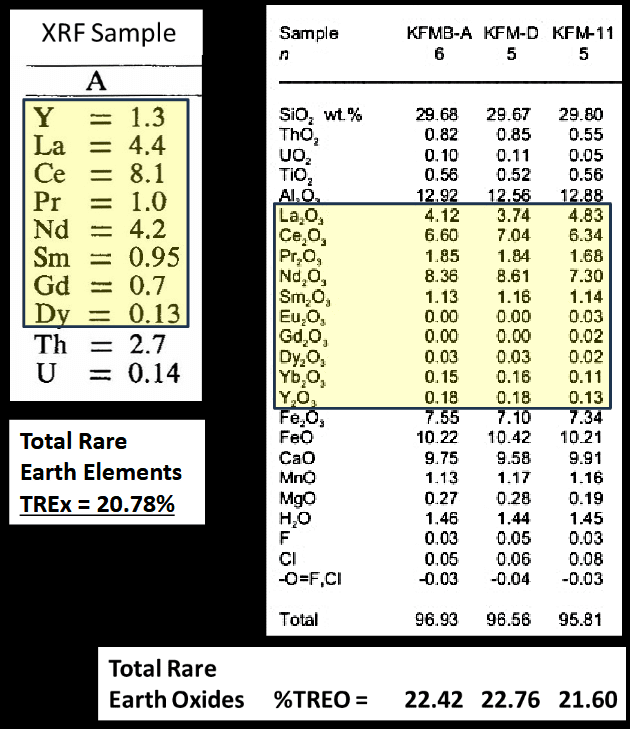
Independent sampling has identified extremely strong Light Rare Earth Elements (LREEs) using both X-Ray Fluorescence and Rare Earth Oxides (REOs) by ARL- WMQ electron microprobe.

The values represent the % occurrence of Rare Earth Elements within the whole rock sample (100%)

The samples showed extreme LREE concentrations with the highest REE values from Nd and Ce. The totals (yellow highlighted) exceeding 20% of the rock sample.

XRF sample – source the University of Arizona Bulletin 167 Microprobe samples – source The Canadian Mineralogist Vol. 50, pp. 815-824 (2012)

The results from assay values of the Kingman rock show extremely high grade TREO results, typical North American Rare Earth deposits grade between 0.3% to 0.7% TREO, with exceptional high grade deposits averaging 4.0% to 8.0%. To date, analytical results here indicate values between 20% to 22% TREO. With the Magnet Rare Earth Oxides (Nd, Pr, Sm, Dy, Tb) composing over 11% of the rock!

Illinois – The Hicks Dome Project

Target – Heavy Rare Earths

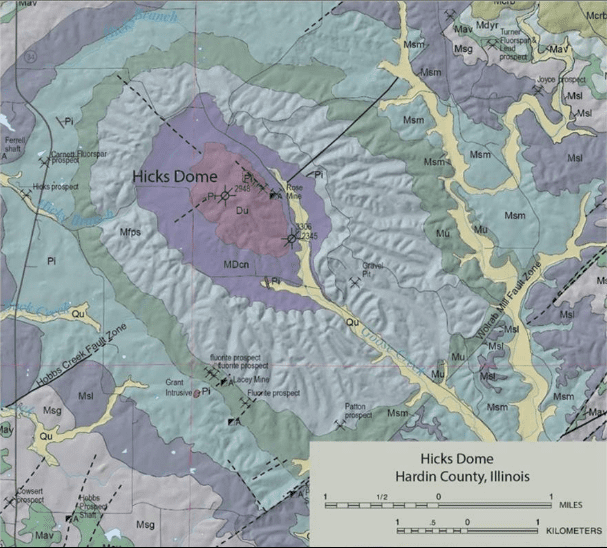
The Hicks Dome is a prominent geological structure located in southern Illinois, an uplifted area with older rock at its center surrounded by concentric rings younger rocks.

The Hicks Dome represents a potentially valuable U.S. based source of “heavy” rare earth elements (HREEs) such as dysprosium, yttrium, and scandium — which are critical for many modern technologies

ree grades - comparables

The projects from the Previous table are now sorted by the weighted average-grade (%TREO)
from the 3 resource categories.

A Unique Opportunity

The Hicks Dome is a large, deeply rooted carbonatitic-alkaline intrusive system that uplifted the surrounding strata and generated extensive hydrothermal activity. Through this combination of structure, magmatism, and fluid-rock interaction, it became enriched in heavy rare earth elements.

Geophysical studies suggest the dome was caused by an alkaline or carbonatitic intrusive complex at depth, emplaced during the mid-Permian (~270 million years ago).

These magmas are the same type associated with REE-enriched carbonatites worldwide like Mountain Pass, Bayan Obo, and Strange Lake; which are some of the worlds largest deposits of REEs.